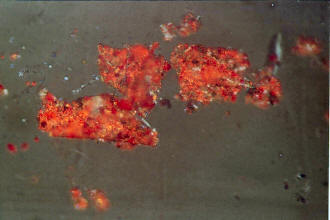
The Shroud of Turin is a centuries-old linen cloth that bears the faint image of a man and reddish stains often claimed to be blood. Kept under tight security in Turin, Italy, the cloth has rarely been made fully accessible to independent researchers, which has fueled speculation and debate about its authenticity. While believers insist the red stains are the blood of Jesus, scientific analysis has repeatedly shown that there is no conclusive evidence to support this claim. The stains contain substances consistent with paint, pigments, and other organic materials, and the conditions required for blood to remain bright red for centuries are highly improbable. The Shroud’s image and “blood” remain a subject of fascination, but careful study suggests that what appears to be blood is most likely not genuine.
MC CRONE
The supposed blood contains paint ingredients. The claim that these ingredients do not come from the blood but from paintings being touched to the cloth is far-fetched.
The research of Walter McCrone has shown that the cloth is a painting and that the blood is really just paint. However, it seems that McCrone may have been too keen to refute the authenticity of the Shroud. His tests showed the presence of a lot of paint on the cloth. He found the blood to contain the pigment red ochre and could not find it outside the image, proving that the claim of believers—that this pigment came from pictures and paintings placed on the Shroud to make them relics—is nonsense (page 27, Looking for a Miracle).
The poker holes on the cloth proved that it was not immune to
damage. There was no way, then, that people would have been allowed
to put damp pictures on the cloth. The usual practice of the Church
was to create relics simply by touching a cloth or item to a holy
object. Relics of St. Padre Pio, for example, are merely touched to
his tomb.
Is the red stuff on the Shroud really blood? It is far from easy to think that it is, for it has remained red. The blood on Jesus would have dried fast in the warm climate, and little of it would have transferred to the cloth—but the Shroud man has plenty of fresh blood!
The pro-authenticity Shroud site http://www.skepticalspectacle.com "explains" that the linen was starched on the loom and then washed in suds of a plant called soapwort. This soap contains haemolytic chemicals, which keep blood red. The blood on the Shroud, it says, contains loads of bilirubin, which is a bile pigment produced by a body that had undergone severe physical trauma. This pigment is red and would not lose its redness. So the believers have two explanations for the blood being red.
But there is no evidence that the linen Jesus would have been buried in was starched. Jews used linen, yes, but it had to be clean, as the purpose was for the body and cloth to rot and leave the bones to be put in a container. It didn’t need any special treatment.
The site, thank goodness, says that the Shroud is natural and denies that radiation from the resurrection put the image on, for radiation cannot do that. At least it disposes of a lot of the nonsense spouted by scientists who are more concerned with promoting fake incentives to Christian belief than the truth. It mentions the claim that the Shroud is a photograph but rejects it on the basis that nobody could have made one like that image long ago. There is no proof, however, that the image people saw 400 years ago is the one we see today. Nobody knows how long ago we are talking about.
We must remember that whoever made the Shroud did a lot of experimenting and probably tried to make a Shroud image from a pierced body. He would have known about the bilirubin thing and may have used real blood with some additives in it. If the Shroud was starched, then how did it fit into the contours of the body so well to pick up images and blood?
It is said that the blood of a person who dies in great trauma can stay red. But that only happens extremely rarely among people who suffer bloodshed. And even then, most of the blood goes brown or darkens in time. It is too hard to believe that Jesus would be “lucky” enough to produce blood that stays red for two millennia! There is no example old enough to verify that it is possible.
Also, considering how hot it was in Palestine at the time Jesus supposedly died, the blood would have rotted fast. Jesus’ blood died long before he died. It would not have stayed red.
The Shroud examiner, Alan Adler, the Jewish blood chemistry expert, was only giving his opinion that if a person suffers great illness or dies in huge trauma, the blood could be gorged with bilirubin and remain red-looking for a long time.
Alan Adler alleged that the Shroud man’s blood was tested and that it did show incredibly high amounts.
A test was administered by Adler, who tested the alleged blood on a fibril of the linen in a protease to see if the protein would dissolve to determine if it really was blood. It did—but other organic substances can do the same, so it proves nothing (page 193, Turin Shroud).
Also, no image was found underneath when the blood was scraped off. This test also fails to prove that there really is no image underneath the blood. The scraping was too small, and the image is hardly distinguishable from the cloth around it in most places anyway.
Since many fibers of the cloth do not have the image, though surrounded by ones that do, nobody knows for sure if the image exists under the blood marks. The iron and the DNA on the Shroud can be accounted for without it necessarily being blood. It is safe to assert that the presence of blood has not been proven and is very unlikely. It is possible and feasible that the pious rich people who had the Shroud in the past might have put some of their own blood on it, thinking that part of them would be close to and mingle with the blood of Jesus.
If the Shroud image is a scorch or photograph, the blood could have been painted or printed—or both—first, and the light reflected on it to make an image that fits the wounds. Those who say it is not a scorch or a painting or a rubbing compare it to images made by these methods. Then they find some differences and deny that any of these explains it. But it will not be the same—the image is hundreds of years old! If you went in a time machine and compared the Shroud as it is now to what it used to be, you would find differences too!
As the Shroud is most probably due to scorch marks, it could be that a forger was using a heated bas-relief statue to make the image. Some think it is a photo of a statue.
But whatever. Maybe the blood could have helped position where the image was going to be projected so that both picture and blood would be positioned correctly. The image was then projected over the blood to match their position. This would leave no image underneath the blood. The believers say that is exactly what they find on the Shroud. They want a projected image, make no mistake, as long as it was a paranormal projection. A real miracle would be able to project the image behind the blood marks. They say that if this happened, we would be saying the image was painted first so that the painter would know exactly where to put the blood. So they make it personal and blame us. God could always find something in the complicated world of chemistry to puzzle us, so there is no need for that accusation. They say that nobody can tempt the Lord God and accuse skeptics of doing that and doing it successfully.
Cesare Nosiglia, Archbishop of Turin, has dismissed new findings supposedly authenticating the Shroud of Turin on the basis that Shroud researchers, such as Professor Fanti, were possibly using “blood” samples from the Shroud that may have been inauthentic. The Shroudie story is that they were left over from other tests done in the past. The Archbishop would wonder why it is only Shroud believers who seem to find them! Stephen Jones and other Shroud believers, with a stubbornness reminiscent of the Medjugorje supporters of a blatantly fake apparition, simply accuse the Archbishop of lying! To cite Shroud devotee Stephen Jones:
“It is bad enough that this current Turin Archbishop is continuing in the telling of a lie about the matter, but it is even worse that he is, in effect, accusing Prof. Fanti of scientific fraud.”
The fact remains that believers are assuming that the red crusts they find on the Shroud are blood. They still fail all of the microscopical, chemical, biological, and instrumental tests for blood.
It is good, though, that Shroud believers—if they are tampering—do not have the nerve to use actual blood samples from elsewhere but use something they can pass off as blood to the believers. They know that the matter is best left without hard “proof” of blood. The world would want to know why, suddenly, after years of testing, the finding of blood is now definite. That it was so hard until now says it all.