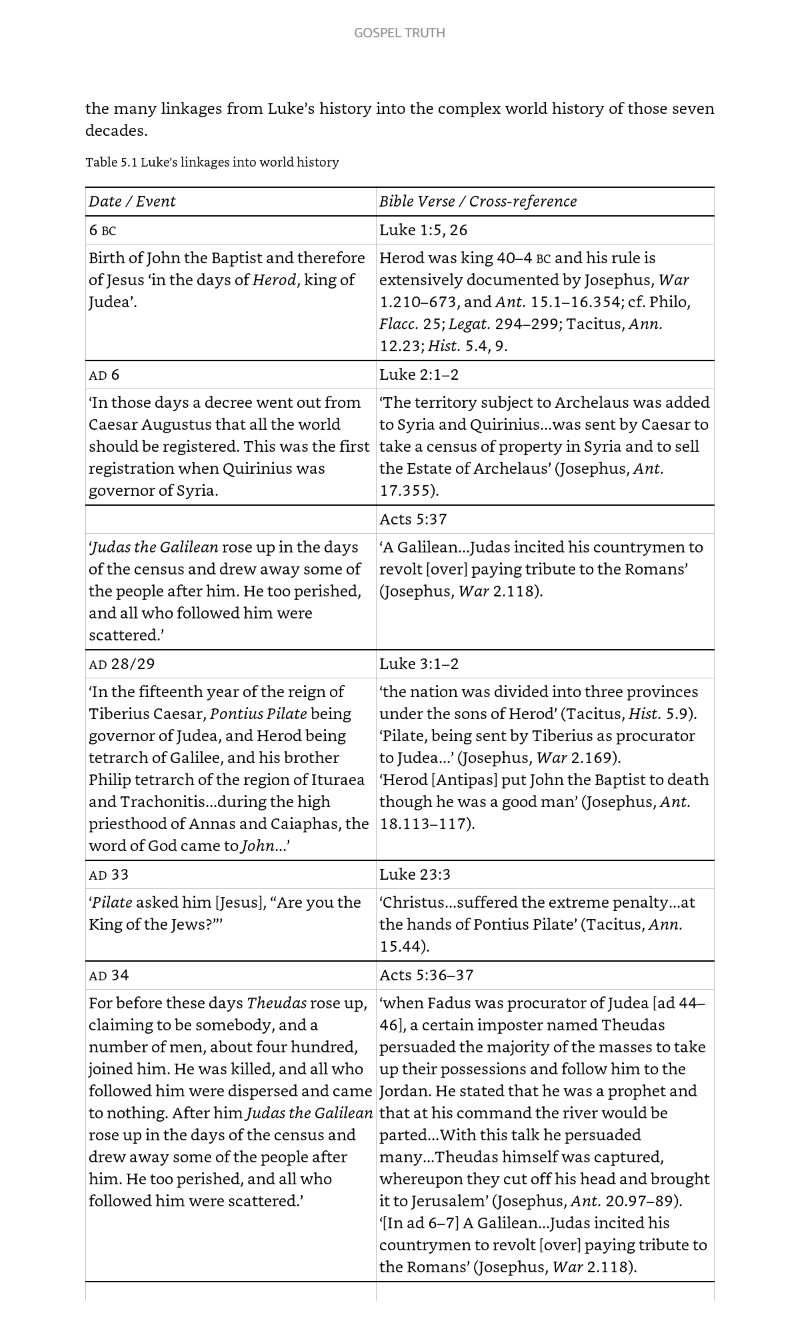
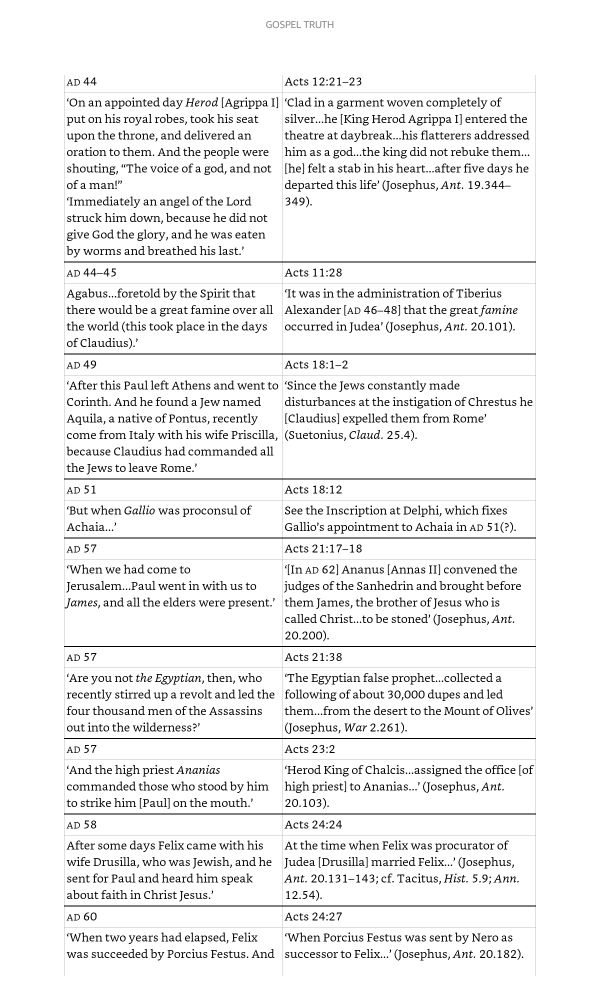
http://members.aol.com/FLJOSEPHUS/LUKECH.htm
A tampered reference to Jesus was written by a Christian and put into Josephus' work.
Here it is.
Now about the same time, a wise man called Jesus, if it be right to call him a man for he was a worker of wonderful works and a teacher of men who like to receive the truth. He won over to him many of the Jews and also many of the Gentiles. He was the Messiah or Christ. Pilate at the request of the chief men among us condemned him to crucifixion. When that happened those who loved at from the first did not abandon him because he appeared to them alive on the third day as the prophets of God had forecasted and not only that but ten thousand other things about him. The tribe of Christians called after him are not extinct even today.”
This website explores how many of the phrases in that Testament have been plucked straight out of the Luke gospel. Since the site is Christian it argues funnily enough that Josephus took Luke's phrases to make the insertion. Josephus would not go to all that trouble but a forger would. The only motive a forger would have for doing that would be so that Luke's gospel would seem more authentic which was only an issue at the end of the second century and later until the canon was settled. The passage was meant for a generation that read the gospel unlike the generation Josephus was a part of. Josephus would have recommended the gospel had he been using it. Plagiarism like that would have been too out of character for Josephus.
The Most Important Line
I found the following on http://members.aol.com/FLJOSEPHUS/testimonium.htm
It explores how whoever wrote the testament seems to be plaigerising the Emmaus story in Luke's gospel where a stranger who turns out to be the risen Jesus enlightens two disciples that he is raised from the dead. Luke 24:19-21 and 24:25-27 are virtually stolen.
Please click me for further information.
Did Josephus write the sentence: "On the third day he appeared to them restored to life, for the prophets of God had prophesied these and countless other marvels about him"?
There are parallels to all the concepts in this sentence at the parallel location in Luke. Moreover, there are peculiarities of vocabulary that appear both in this Josephus passage and in Luke at this point. Most noteworthy, the odd use of the accusative form of the third day (literally, "having/spending a third day") hat is found in both texts are the only two instances of this usage in Christian literature. With such an amazing grammatical parallel at corresponding locations and conveying the same themes, one can only conclude that the two texts closely follow the same source document. Since there is no reason why a later Christian scribe would so closely follow the Emmaus narrative of Luke, we conclude that this phrase appeared in the original Josephus passage in substantially the form we have it now.
This is confirmed by the appearance of a similar sentence in the version of Agapius. There is one significant difference in Agapius: the sentence is preceded by "They reported..." This simple phrase takes away any idea that Josephus was expressing Christian beliefs he held himself. As this idea of a report is also fundamental to the Emmaus narrative (the narrative is such a report), we can with good confidence assert that this is the form in which the Josephus passage originally appeared.
I wish to comment that the line is the most important one for Christians as it speaks of the resurrection claims. Yet there is another reason to dismiss it.
Catholic scholar Meier offers this as the real thing that Josephus wrote but without the bolded letters, "About this time there appeared Jesus, a wise man, if indeed one should call him a man. For he was a doer of startling deeds, a teacher of people who receive the truth with pleasure. And he gained a following both among many Jews and among many of Greek origin. He was the Messiah. And when Pilate, because of an accusation made by the leading men among us, condemned him to the cross, those who had loved him previously did not cease to do so. For he appeared to them on the third day, living again, just as the divine prophets had spoken of these and countless other wondrous things about him. And up until this very day the tribe of Christians, named after him, has not died out." And he justifies it thus, "In short, the first impression of what is Christian interpolation may well be the correct impression. A second glance confirms this first impression. Precisely these three Christian passages are the clauses that interrupt the flow of what is otherwise a concise text carefully written in a fairly neutral - or even purposely ambiguous - tone" ( John P. Meier, A Marginal Jew: Rethinking the Historical Jesus (Doubleday, 1991, page 61).
Conclusion
The Testament is no good if it is just borrowing from Luke for if Luke is wrong so is it.
We conclude that the author of the gospel of Luke was taking stories from Josephus. His works must have been esteemed among many early Christians one of whom went so far as to put a Luke-derived testimony to Jesus that reads like a creed in Josephus!
Though many say it does not matter if it is forged or not it does matter. It makes the forger a liar. Why would somebody need to do something like that if the Jesus story was really true?
http://www.josephus.org/testimonium.htm