The Turin Shroud is the most famous relic in the world. Millions believe it is the burial cloth of Jesus Christ, bearing his crucified and bloodied image. The cloth is kept in Turin, Italy. It remains an enigma, and many consider it a miracle.
The Turin Shroud is the most famous relic in the world. Millions
believe it is the burial cloth of Jesus Christ, bearing his
crucified and bloodied image. The cloth is kept in Turin, Italy. It
remains an enigma, and many consider it a miracle.
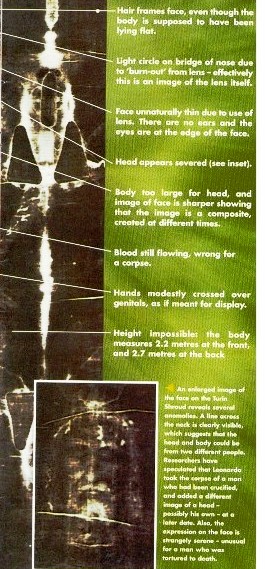
The man depicted, however, was not Jesus Christ, for Jesus was not decapitated; he supposedly died on a cross. The head of the Shroud man is not in a natural position. According to X Factor, Issue 31 (Marshall Cavendish, 1997, pp. 858–859), computer digitalisation shows that the image stops at the line on the neck, which resembles a slit throat, and then starts again in the upper chest—leaving no neck or body in between.
For several reasons, I agree that the cloth depicts a decapitated man.
As Rodney Hoare observed in A Piece of Cloth, the front of the head is narrower than the back. He suggests a pillow caused this discrepancy, but this is implausible: the fall of the hair indicates there was no pillow, and there is no evidence to support his claim. A line across the neck resembles a cut. If it is indeed a cut, the blood must have been wiped away to create the impression that the image depicted Jesus.
The back image measures 2.7 meters in height, while the front is 2.2 meters. This suggests the back is a complete image, whereas the front shows a body without a head, to which a separate head was added later. The head image may have been elongated to match the height of the back image, making the front image a composite.
The body appears too large and muscular for the gaunt, skinny head.
The hair frames the face, which contradicts the rest of the Shroud, showing a man lying down. The head is separate from the body, but only in the front image. The hair and beard have a color not found elsewhere on the cloth. The man shows no chest, pubic, or leg hair. Some suggest the body hair was dark and invisible to whatever photographic method was used, so the beard and hair were powdered white to make them appear. Another possibility is that the head does not belong with the body. It seems unlikely that Jesus lacked sufficient body hair to affect the image; the real Jesus should have had more.
The body shows significant blood flow even from small cuts. The head bears most of them, including wounds consistent with a crown of thorns, yet it does not display enough blood to match the body. The hair is not matted with blood. The body shows more bleeding from pre-crucifixion marks than from the crown of thorns.
Evidence of bleeding suggests the man was alive, yet there is no indication that his breath distorted the mouth area—the mouth is plain, undistorted, and among the sharpest images on the cloth. The head does not belong to the body; the blood appears to have been applied deliberately.
Regardless of who the body belongs to, the face is not the face of Christ.
Christians may offer explanations to dismiss these observations, but it is simpler to believe the head is separate. Excessive rationalization and speculation often indicate a desire to deceive oneself or others.
Isabel Piczek, a leading expert on the Shroud man and an artist, attempted to use models to recreate the Shroud’s pose, but this proved impossible: the head would not align correctly. The unusual clarity of the face and its wounds, compared to the rest of the image, points to human intervention rather than divine creation. The sharpness could indicate decapitation.
Experts like Piczek, despite their reluctance, acknowledge that the head appears severed (The Divine Deception, p. 265). This does not imply that Jesus was beheaded, as there is no blood unless it was wiped away—perhaps to maintain the appearance of a head attached by a neck bandage. When laid in the tomb, the head would not need attachment; it simply needed to align with the body. The head is too small for the body, as both the naked eye (Turin Shroud, p. 135) and computer analysis (Turin Shroud, p. 145) reveal. Some suggest the head was placed first, with the body lying on top of the hair at the back, making a bandage unnecessary.
The gap in the negative image at the neck indicates the head is separate. It cannot be explained by draping like other instances can. The beard appears to hang down over the blank area, as if the man were standing erect, yet the start of the neck is visible with no image transferred. This supports the conclusion that the head was never part of the body. If it had belonged, the head could be repositioned to appear normal—but the neck is too short, and the head too small (The Divine Deception, p. 262).
Some suggest Jesus’ head was embalmed and used to create the Shroud’s face, while the body belonged to a decapitated man. Others propose the head belonged to John the Baptist. Turin Shroud by Prince and Picknett reports that STURP photographs and infrared images show the head bears no sign of belonging to the body. 3-D images by John Jackson and Eric Jumper reveal the same effect. The image appears composite, with the head size inconsistent with the body.
Conclusion
The Shroud man is not Jesus Christ.
APPENDIX
Some researchers argue that the face region exhibits differing optical, anatomical and imaging characteristics (sharpness, clarity, proportions) compared to other parts of the body image, which may imply the face was handled or formed differently.
A recent study published in Archaeometry (2025) by Cicero Moraes used 3‑D simulation software to compare how fabric drapes over a three‑dimensional human body versus a low‑relief sculpture. The results showed that when a cloth is wrapped around a real body the image becomes distorted (wider, uneven), but when draped over a shallow relief the resulting imprint matches closely the proportions and clarity of the Shroud’s image.
Additionally, detailed scans of the linen demonstrate a gap at the
top of the head region between the front and back images — namely,
the “top of the head” appears missing, contrary to what one would
expect if a full human head had been enclosed within the cloth.
shroud.com
Together these findings suggest the image may not originate from a body being wrapped in the cloth in the usual way, which supports the observation that the head appears “separate” from the body image.
BOOKS CONSULTED
Ante-Nicene Christian Library, Roberts and Donaldson, T&T Clark, Edinburgh, 1870
Biblical Exegesis and Church Doctrine, Raymond E Brown, Paulist Press, New York,
1985
Free Inquiry, Spring 1998, Vol 18, No 2, Article by Joe Nickell, Council for
Secular Humanism, Amherst New York
From Fasting Saints to Anorexic Girls, Walter Vandereycken and Ron van Deth,
Athlone Press, London, 1996
Holy Faces, Secret Places, Ian Wilson, Corgi, London, 1992
Inquest on the Shroud of Turin, Joe Nickell, Prometheus Books, Buffalo, NY, 1987
Jesus Lived in India, Holger Kersten, Element, Dorset, 1994
Looking for a Miracle, Joe Nickell, Prometheus Books, New York, 1993
Miracles, Ronald A Knox, Catholic Truth Society, London, 1937
Sceptical Inquirer 9/10 2001 Vol 25, No 5, Article by Joe Nickell, CSIOCP,
Amherst New York
Relics, The Society for Irish Church Missions, Bachelor’s Walk, Dublin
The Blood and The Shroud, Ian Wilson, Orion, London, 1999
The Book of Miracles, Stuart Gordon, Headline, London, 1996
The Divine Deception, Keith Laidler, Headline, London, 2000
The DNA of God?, Leoncio A Garza-Valdes, Doubleday, 1999
The Holy Shroud and Four Visions, Rev Patrick O Connell and Rev Charles Carty,
TAN, Illinois, 1974
The Holy Shroud and the Visions of Maria Valtorta, Msgr Vincenzo Celli, Kolbe
Publications Inc., Sheerbrooke, California, 1994
The Image on the Shroud, Nello Ballosino, St Paul’s, London, 1998
The Jesus Conspiracy, Holger Kersten amd Elmar R Gruber, Element, Dorset, 1995
The Jesus Relics, From the Holy Grail to the Turin Shroud, Joe Nickell, The
History Press, Gloucestershire, 2008
The Pagan Christ, Tom Harpur, Thomas Allen Publishers, Toronto, 2004
The Second Messiah, Christopher Knight and Robert Lomas, Arrow, London, 1998
The Skeptic’s Guide to the Paranormal, Lynne Kelly, Allen & Unwin, Australia,
2004
The Shroud, The 2000 Year Old Mystery Solved, Ian Wilson, Bantam Press, London,
2010
The Turin Shroud is Genuine, Rodney Hoare, Souvenir Press, London, 1998
The Turin Shroud, Ian Wilson, Penguin Books, Middlesex, 1979
The Unauthorized Version, Robin Lane Fox, Penguin, Middlesex, 1992
Turin Shroud, Lynn Picknett and Clive Prince, BCA, London, 1994
Verdict on the Shroud, Kenneth E Stevenson and Gary R Habermas, Servant
Publications, Ann Arbour, Michigan, 1981