Free will, at its most basic, means that a person can choose between alternatives and is genuinely the source of the choice made. It denies that the person is merely a passive product of external programming or conditioning.
1. Two senses of “free will”
There are two importantly different ways to understand free will:
(a) Free will to do good or harm (non-moral good and harm)
In this sense, free will refers to the capacity to help or hinder others without invoking moral accountability. For example, a cat helping her kitten performs a beneficial action, but the cat is not a moral agent. There are no concepts of guilt, praise, sin, or virtue involved. This sense of free will does not presuppose moral law.
(b) Free will to do moral good or moral evil
This second sense involves moral responsibility, including approval and disapproval, reward and punishment. Within religious frameworks, especially Christian theology, this is where sin arises. Sin is not merely causing harm; it is wrongdoing understood as a violation of God’s will. Holiness is its opposite: acting in accordance with what is morally right before God.
Only the second sense of free will involves sin. The first does not.
2. Moral wrong versus sin
It is possible to believe that certain actions—such as deliberately harming others—are morally wrong without believing that they are sins. One may affirm moral norms while denying that these norms are grounded in God or that violating them constitutes disrespect toward God.
If moral good and evil are not ultimately about God, then sin, as traditionally defined, does not exist—even though moral wrongdoing may still exist.
3. Is free will compatible with always choosing good?
It is often claimed that free will requires the real possibility of choosing evil. According to this view, if God (or nature) ensures that a person will always choose good, then the person is no longer free.
This concern is largely theological rather than philosophical. Many Christian thinkers insist on libertarian free will because they want moral evil to originate in human beings rather than in God. They also require free will to include the possibility of sin, not merely the ability to bring about beneficial or harmful outcomes.
However, this assumption is questionable.
4. Character, gradual choice, and the illusion of sudden decisions
What appear to be sudden, out-of-character moral failures are rarely sudden at all. A person who has spent a lifetime saving lives but later commits a grave wrongdoing has almost certainly undergone a long, unnoticed process of character change. The final action may occur in a moment, but the decision was formed gradually over time.
We often think of decisions as instantaneous acts, but many decisions are effectively made long before the final action occurs. The action merely completes a decision already underway.
This insight undermines the idea that free will requires constant unpredictability or the ability to act radically out of character at any moment.
5. Programming, character, and freedom
Some argue that if God created humans with a nature inclined only toward good, this would eliminate free will. This argument assumes that freedom requires the ability to choose arbitrarily between good and evil at any moment.
But this ignores how character actually works. Over time, we shape ourselves through repeated choices. In doing so, we “program” ourselves. Our present freedom is constrained by our past freely chosen character. You cannot simply erase your character at will.
In that sense, all of us already live within a “straitjacket” created by our earlier selves. If self-programming does not destroy freedom, then neither would divine programming that results in a consistently good character.
What matters is not who programs the character, but whether the resulting actions genuinely flow from the person.
6. The myth of acting “out of character”
There is no such thing as a truly out-of-character act. If a lifelong good neighbor suddenly behaves violently, either the act is a momentary anomaly that does not define the person, or the person’s character was never as good as it appeared and had been developing unseen defects over time.
Thus, such cases do not show that free will requires radical unpredictability.
7. Determination, nature, and divine design
Many believe that something already ensures we choose what we choose—whether biology, psychology, upbringing, or environment. If so, it is unclear why this determining influence could not instead ensure that we always choose what is good.
Whether one is a theist or an atheist, the question remains: if humans are biological systems shaped by causes, why assume that this eliminates freedom only when the outcome is moral goodness?
Even if God exists, He could design nature and environment in such a way that persons freely develop good character. Free will and reliably choosing good because of one’s nature or history are not incompatible.
Conclusion
Free will, understood as the genuine capacity to choose among alternatives for which one is the true source, does not logically require the possibility of sin. The common confusion arises from failing to distinguish between:
Free will in a general, non-moral sense, and
Free will understood as moral agency before God.
If moral good and evil are not ultimately grounded in God, then sin may not exist at all. Even within theistic frameworks, the gradual formation of character—whether through self-shaping or divine design—shows that a person may act freely while being unable to sin.
Therefore, free will and the inability to sin are not contradictory. They are compatible within a coherent and realistic understanding of human freedom.
Appendix: The Paradox of Free Will
If free will is real, it is inherently paradoxical. It may therefore be reasonable to suppose that free will could exist even in the absence of the ability to sin.
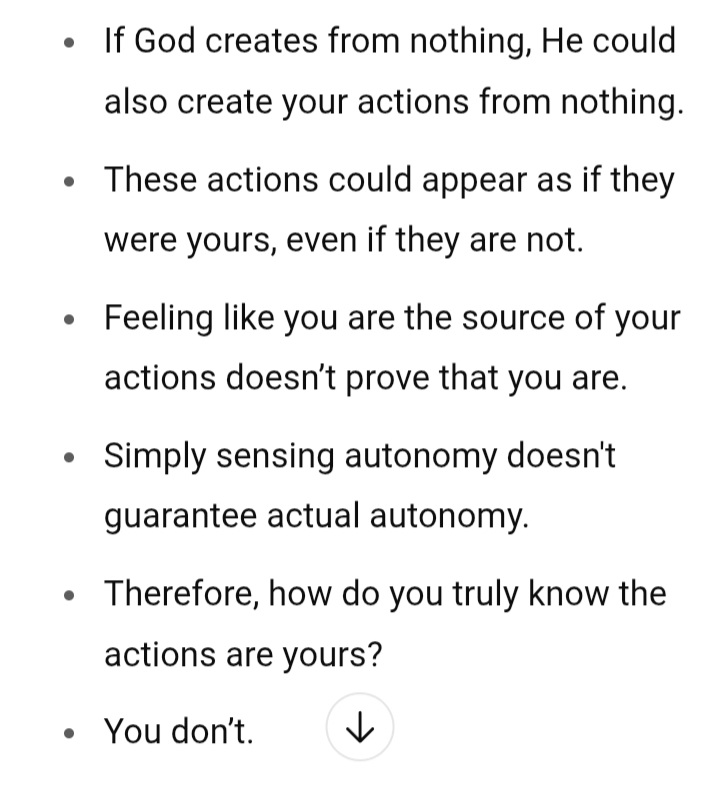
If God creates ex nihilo, then even our actions might ultimately depend on divine creation. Our sense of being the source of our choices does not guarantee that we truly are. We infer freedom; we do not directly observe it.
Moreover, if choices truly arise “from nothing,” then only God could be their ultimate source, since creation from nothing belongs to God alone. This raises a deeper question: does free will ultimately contradict itself?
Perhaps free will is less about absolute independence and more about actions flowing from who we are—even if who we are is shaped, sustained, or enabled by God.
BOOKS CONSULTED
AN INTELLIGENT PERSONS GUIDE TO CATHOLICISM, Alban McCoy, Continuum, London and New York, 1997
AN INTRODUCTION TO PHILOSOPHICAL ANALYSIS, John Hospers, Routledge, London, 1992
APOLOGETICS AND CATHOLIC DOCTRINE, Most Rev M Sheehan DD, MH Gill & Co, Dublin, 1954
ARGUING WITH GOD, Hugh Sylvester IVP, London, 1971
CONTROVERSY: THE HUMANIST CHRISTIAN ENCOUNTER Hector Hawton, Pemberton Books, London, 1971
EVIL AND THE GOD OF LOVE, John Hicks, Fontana, London, 1977
FREE INQUIRY, Do We have Free Will? Article by Lewis Vaughn and Theodore Schick JR, Spring 1998. Vol 18 No 2, Council for Secular Humanism, Amherst, New York
GOD AND EVIL, Brian Davies OP, Catholic Truth Society, London, 1984
HANDBOOK OF CHRISTIAN APOLOGETICS, Peter Kreeft and Ronald Tacelli, Monarch, East Sussex, 1995
MORAL PHILOSOPHY, Joseph Rickaby SJ, Stonyhurst Philosophy Series, Longmans, Green and Co, London, 1912
PHILOSOPHICAL DICTIONARY, Voltaire, Translated by Theodore Besterman, Penguin, London, 1972
RELIGION IS REASONABLE, Thomas Corbishley SJ, Burns & Oates, London, 1960
THE BIG QUESTIONS, Simon Blackburn, Quercus Books, London, 2009
THE CASE AGAINST GOD, Gerald Priestland, Collins, Fount Paperbacks, London, 1984
THE LIFE OF ALL LIVING, Fulton J Sheen, Image Books, New York, 1979
THE PUZZLE OF GOD, Peter Vardy, Collins, London, 1990
THE REALITY OF GOD AND THE PROBLEM OF EVIL, Brian Davies, Continuum, London-New York, 2006
THE TEACHING OF THE CATHOLIC CHURCH, Ed. Canon George D Smith, Ph.D. Burns and Oates and Washbourne, London, 1952
THE TRUTH OF CHRISTIANITY, WH Turton, Wells Gardner, Darton & Co Ltd, London, 1905
UNBLIND FAITH, Michael J Langford, SCM, London, 1982
WHY DOES GOD? Domenico Grasso SJ, St Paul's, Bucks, 1970
BIBLE QUOTATIONS FROM:
The Amplified Bible
THE WWW
www.ffrf.org/fttoday/august97/barker.html
The Free Will Argument for the Non-Existence of God by Dan Barker