In 2002, a "shroud" was found there in a first century tomb as part
of a cemetery. It was discovered by Professor Shimon Gibson.
The shroud was intact for it was in a sealed part of the tomb for
the man had leprosy. It makes you wonder that if Jesus was sealed
off too and so well that nobody knew he was there. Both Jesus and
the man were unclean in the eyes of Jewish tradition.
The shroud was cut up into sections. The face cloth had to be separate in case it had to be lifted off should the person prove to be alive. Jesus if he predicted a resurrection would have definitely had a facecloth. The rule of Bible interpretation is that you interpret it according to what you learn about the time it was written. The John gospel speaks as if Jesus' cloth was also in pieces. "What our shroud shows is that the practice of having a separate shroud or wrapping for the body and for the head was common practice. There was a separate wrapping for the head itself, which was very important because when they brought someone to burial they would place the head wrapping separately on the face in case the person wasn't actually dead and woke up again, they would be able to blow off the face wrapping and shout for help" so Shimon Gibson says.
Anyway it enclosed the remains of a man who died in his thirties who was definitely a member of the High Priestly aristocratic caste. Yet this man was buried in a patchwork made up of woolen and linen material all sewed together. It is a simple cross-weave. The Turin Shroud is linen and has a more complex weave - the twill weave. Even the way the man was laid out in the Shroud is totally different from the Turin Shroud layout.
The wealthy Sanhedrin member and Jewish priest, Joseph of Arimathea is believed to have bought the shroud that Jesus was put in. He would therefore have bought a shroud like the Hinnom one because it would be the fashion and easy to get. And if he expected Jesus to rise – the gospels hint that he did for they say he was a follower of Jesus - it would be madness going for an especially expensive shroud and he would have got into trouble with his friends for using a better shroud than what they and their dead relatives would be put in when Jesus was considered an enemy of Israel and Judaism. The Hinnom cloths have been dated to the first century by carbon dating. Now this "shroud" has been through a lot more environmental abuse – from extremes of temperature, being in a cave with scorpions and what-not for company and having a body rot in it – than the Turin Shroud. This tells us that if the carbon dating was right for it - and it is - then it is even more right for the Turin Shroud which is shown to have had originated in medieval times.
There is no resemblance at all between this burial and what the Turin Shroud claims for Jesus. And that is made more stark by the fact that the man lived and died and was buried in Jesus' day.
You would wonder if this man was buried so well that people thought his body vanished and that inspired the notion that Jesus rose. Makes you wonder that if Jesus went to a tomb did he leave it at all?
The shroud is the total opposite of the Turin Cloth in every respect and it was found in Jesus' backyard and dates from his time. Worse it is like Jesus' tomb, the tomb of a rich person. What is that saying? It speaks far louder than anything else.
The Turin Shroud is refuted by how it is made of a strong weave that was clearly meant to last and be right to hold an image as it was so smooth. A real shroud would be as unsexy and ordinary as the Hinnom shroud.
It could have been Jesus' shroud! If Jesus had a shroud it was like it!
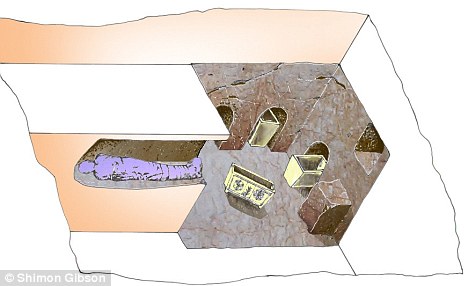
Map of the Hinnom tomb with the shroud man's location
APPENDIX - HINNOM SHROUD IS NOT ONLY EXAMPLE SHOWING TURIN CLOTH IS
FAKE
JOE NICKELL
As if there were not already enough evidence debunking the Shroud of
Turin, the historical record, a forger's confession, tempera paint,
and multiple carbon-dating tests, now new evidence further
discredits the authenticity of the reputed burial cloth of Jesus.
The new finding is the 2,000-year old skeletal remains of a
crucified Roman. It was reported on Live Science (How Jesus Died:
Rare Evidence of Roman Crucifixion Found by Tom Metcalf, https://www.LiveScience.
com/62727-jesus-roman-crucifixion-found.html). The June 4 article
de-scribed examination of the bones (originally discovered in 2007
near Venice) as revealing a lesion together with an unhealed
fracture located on one heel bone. The discovery is quite revealing
because it is consistent with the only other apparent crucifixion
wound known to archaeology.
The discovery is quite revealing because it is consistent with the
only other apparent crucifixion wound known to archaeology.
That earlier discovery came in 1968 with the excavation of a
Jerusalem tomb bearing the inscription Jehohanan. That victim's heel
bone was still attached to a piece of wood by a nail driven through
the side of the heel (see my book Inquest on the Shroud of Turin
[62, v65]). (In neither instance was there clear evidence of the
wrists being nailed, and it is assumed they were tied.)
While the nailed heels of the 1968 and 2007 discoveries are mutually corroborative, they do not support either of the foot placements depicted for Jesus in Christian art. The earliest representations showed the feet nailed separately, side by side; much later depictions had one foot crossed over the other and both secured by a single nail. The Shroud of Turin, which appeared in the middle of the fourteenth century, has the feet placed separately, although the left one points inward, indicating the artist probably intended to suggest a crossed-feet position, which by then was conventional.
Thus, admittedly very limited data suggests that the foot placement represented on the Shroud of Turin is incompatible with the two known burials of actual crucifixion victims. Instead, the Shroud placement matches the more recent of two styles imagined by artists as well as copious data (e.g., radiocarbon dating) that identifies the cloth as fourteenth century. That is consistent with a fourteenth-century bishop's report that a forger confessed to having cunningly painted the image.
Joe Nickell is CSI's senior research fellow and SI's Investigative Files columnist. He is author of, among many other books, Inquest on the Shroud of Turin (Prometheus Books, 1998).
APPENDIX
Back to basics: the context of Jewish burial customs
In 2009, it was reported that a genuinely first-century CE burial
shroud had been discovered in the Hinnom valley in Jerusalem. This
is the first discovery of its kind and provides the first material
with which to compare the Turin Shroud. This shroud was found in a
tomb that had been partly disturbed by looters, which is why
Professor Shimon Gibson from the Israel Antiquities Authority
excavated it completely. As usual, the looters were looking for
saleable artefacts, such as ossuaries, and had left the shroud
fragments as valueless.
The survival of the cloth is unusual and seems to have occurred
because, unusually, the tomb was completely sealed with plaster,
which had prevented the tomb from becoming damp. Furthermore, the
relatives of the man buried in the shroud had not returned to gather
up the strips of cloth for deposition in an ossuary. The reason for
this appears to have been that the deceased had suffered from
leprosy and tuberculosis, which were detected in DNA samples taken
from the surviving bones.
So how do the characteristics of this certainly first century CE cloth compare with those of the Turin Shroud? Firstly, the “Hinnom Shroud”, as it may be called, is not a single piece of cloth. Rather, it consists of a mixture of woollen and linen cloths, stitched together into a patchwork, unlike the single piece of linen that comprises the Turin Shroud. There is also a separate piece of cloth to cover the face, which is what would be expected from what we know of Jewish burial customs of the period. Secondly, whereas the weave of the Turin Shroud is a type known as twill, a weave with a characteristic diamond pattern (denim is a cloth with twill weave), that of the “Hinnom Shroud” is a simple cross-weave. Twill was unknown in the Middle East until the medieval period, which has long been seen as a problem for the Turin Shroud’s authenticity as the burial cloth of a Jew of the first century CE. Now we have an undisputed shroud from the right time and place, it does not have a twill weave. Moreover, it conforms more to what we would expect from a Jewish burial cloth rather than to something a medieval artist might imagine one to have been.
The “Hinnom Shroud” consists of a patchwork of cloths with a separate piece for the head, all made in a plain two-way weave, quite unlike the Turin Shroud. Going back to the Gospels – our only sources of information about the burial of Jesus – we find that they mention not a single cloth but “strips of linen” (Luke XXIV.12 and John XX.5, both using the Greek plural word ὀθόνια, meaning ‘small pieces or strips of linen’). Supporters of the authenticity of the Turin Shroud are careful not to quote these passages, which show that the evangelists did not think of the body of Jesus as ever having been wrapped in a single linen cloth.