Barbara Smoker wrote:
"You may choose to act the way you wish, but you do not choose the way you wish to act."
This captures an important truth: while we can decide how to act, we cannot directly control our feelings, impulses, or desires. For example, we cannot will ourselves into or out of love, sadness, or depression. Even efforts to “help ourselves” only work because other feelings exist that respond to those efforts. Our feelings shape our actions, and in this sense, what we call “choice” is determined by what we feel.
If you love your child, for instance, you cannot act against that love, regardless of your free will. Free will does not grant mastery over feelings; it is shaped by them. The sense of freedom arises because our feelings guide our actions, giving the impression that we act freely.
A more precise formulation might be:
"You may choose to act in a way you wish, but the seeming freedom of that choice is shaped by feelings you do not control."
Free Will: The Concept
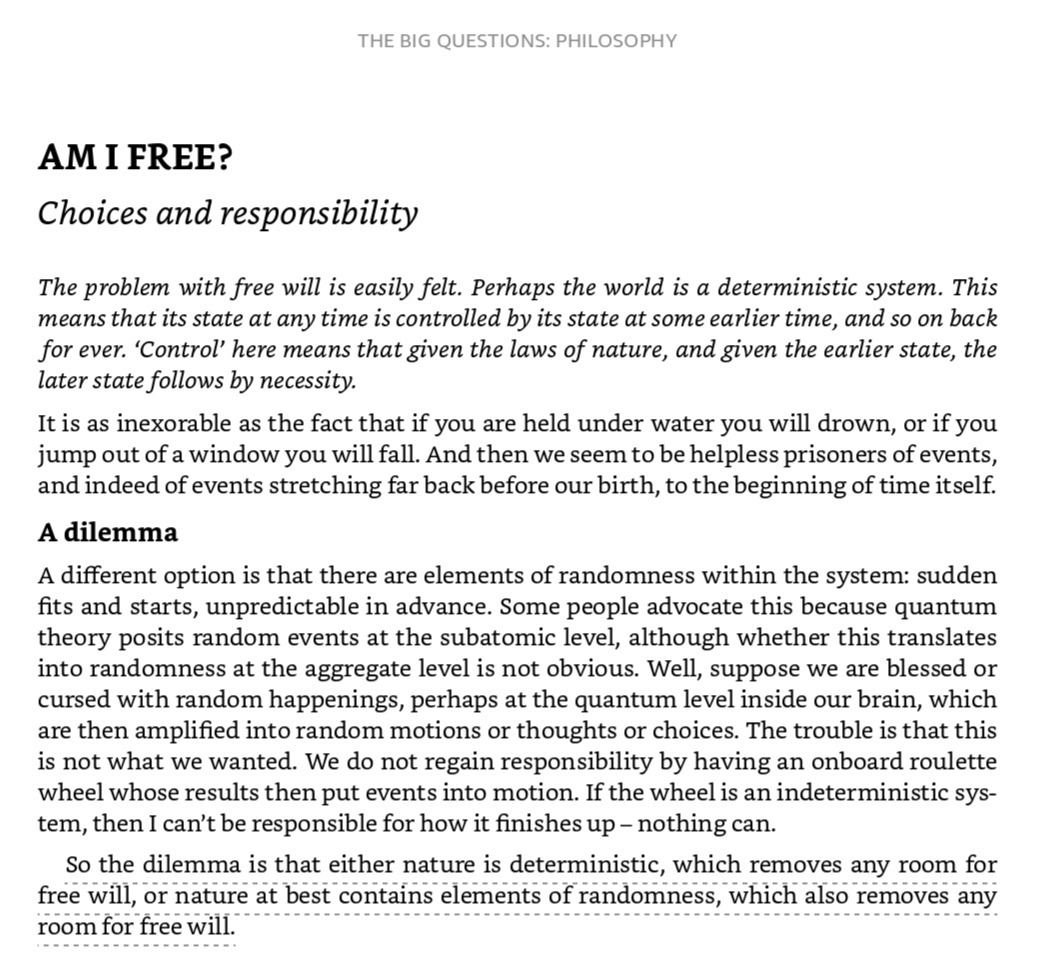
Free will is traditionally understood as the ability to make choices independently of deterministic causes. It assumes:
You alone cause your actions.
If you could have done X, you could equally have done Y.
Almost everyone believes in some notion of a “will,” but not all believe it is genuinely free. Philosophical positions break down into three categories:
Determinism – All choices are caused by prior circumstances.
Indeterminism – Choices are uncaused, spontaneous events.
Compatibilism – A reconciliation attempt: choices are caused, yet we remain “free.”
Determinism
Determinism denies free will. It holds that every choice results from prior causes—genetics, upbringing, environment, and past experiences. We feel free, but our decisions are compelled by these causes.
Determinism does not conflict with the idea of an all-knowing God: foreseeing our actions does not imply causing them.
Rejecting determinism does not automatically prove free will exists. Even if determinism is false, the nature of free will remains unresolved.
Indeterminism
Indeterminism claims choices are uncaused. They do not stem from past events, genes, or environment—they simply happen. On the surface, this seems like freedom.
But true freedom requires coherence and responsibility. If choices are causeless:
They are unpredictable and possibly irrational.
No meaningful effort or moral guidance can influence behavior.
The “self” does not generate choices; they emerge randomly.
Thus, indeterminism paradoxically undermines free will. A choice that arises from nothing is not genuinely ours. Even if subatomic events are indeterminate, this does not grant meaningful freedom at the human level.
Religious notions of a spiritual soul sometimes rely on indeterminism to justify moral responsibility, but basing ethical systems on unprovable assumptions is questionable.
Compatibilism
Compatibilism attempts to reconcile determinism and free will: our actions are caused, yet we are considered “free.”
This is largely regarded as philosophically incoherent:
Determinism denies free will.
Indeterminism cannot reliably produce responsible free choice.
Combining the two does not resolve the fundamental problem—it merely pretends freedom exists.
Observations About Freedom
Even if we assume some degree of freedom:
Belief is necessary. If we do not believe we are free, the mind may inhibit our ability to act.
Freedom is constrained by circumstances, feelings, and consequences.
True moral freedom—freedom to act responsibly and ethically—cannot exist independently of causality or constraints.
The sense of free will may largely arise from self-awareness, rather than actual autonomy. Consciousness gives us the feeling of freedom, but it does not guarantee the ability to act independently of desires, feelings, or prior causes.
Conclusion
Free will, in the traditional sense of being fully autonomous, is logically problematic.
Determinism explains why choices follow prior causes.
Indeterminism cannot establish responsible choice, as uncaused events are not controlled by the self.
Compatibilism fails to reconcile these contradictions.
Ultimately, the freedom we experience is largely the freedom to act within the constraints of our feelings, thoughts, and circumstances. True self-awareness may be the closest we get to “freedom,” while absolute free will remains elusive.
.
A huge pile of events random and not random that make you act, will make you feel free. Random things look free for we confuse free and unpredictable. We are told that we are free for we feel free. But we know that is not true. Too much drink makes you feel super-free though it is making you an idiot. You think your computer is your friend and you feel it is freely about you. Yet deep down you know different. Not only do we feel free but we project that unto things we know are not free. We enter a cycle where we feel more free the more we feel other things are free.
How can you call yourself free when you are not free to know but have to depend on a feeling? You cannot call yourself seeing if you need a feeling to tell you the cat is in front of your eyes.
BOOKS CONSULTED
A CONCISE INTRODUCTION TO PHILOSOPHY, William H Halverson, Random House, N.Y. 1967
BASIC PHILOSOPHICAL ANALYSIS, Charles C Reid, Dickenson, CA, 1971
BEYOND GOOD AND EVIL, Friedrich Nietzsche, Penguin, London, 1990
CONTROVERSY: THE HUMANIST CHRISTIAN ENCOUNTER Hector Hawton, Pemberton Books, London, 1971
DOING AWAY WITH GOD? Russell Stannard, Marshall Pickering, London, 1993
FREE TO DO RIGHT, David Field IVP London, 1973
GOD A GUIDE FOR THE PERPLEXED Keith Ward, OneWorld, Oxford, 2003
GOD AND THE NEW PHYSICS, Paul Davies, Penguin Books, London, 1990
HANDBOOK OF CHRISTIAN APOLOGETICS, Peter Kreeft and Ronald Tacelli, Monarch, East Sussex, 1995
MORAL PHILOSOPHY Joseph Rickaby SJ, Stonyhurst Philosophy Series, Longmans, Green and Co, London, 1912
MORTAL QUESTIONS, Thomas Nagel, Cambridge University Press, Cambridge, 1979
ON THE TRUTH OF THE CATHOLIC FAITH, BOOK ONE, GOD, St Thomas Aquinas, Image Doubleday and Co, New York, 1961
PHILOSOPHICAL PROBLEMS AND ARGUMENTS, James W. Cornman and Keith Lehrer, 2nd Edition, Macmillan Network, 1974
PHILOSOPHY – THE PURSUIT OF WISDOM, Louis P Pojman, Wadsworth, California, 1994
RADIO REPLIES VOL 1, Frs Rumble & Carty, Radio Replies Press, St Paul, Minnesota, 1938
RADIO REPLIES VOL 2, Frs Rumble & Carty, Radio Replies Press, St Paul, Minnesota, 1940
RADIO REPLIES VOL 3, Frs Rumble & Carty, Radio Replies Press, St Paul, Minnesota, 1942
REASON AND RELIGION, Anthony Kenny, Basil Blackwell Ltd, Oxford, 1987
RELIGION IS REASONABLE, Thomas Corbishley SJ, Burns & Oates Ltd, London, 1960
THE END OF FAITH, RELIGION, TERROR AND THE FUTURE OF REASON, Sam Harris, Free Press, London, 2005
THE FUNDAMENTAL QUESTIONS OF PHILOSOPHY, AC Ewing, Routledge and Kegan Paul, London, 1985
THE REALITY OF GOD AND THE PROBLEM OF EVIL, Brian Davies, Continuum, London-New York, 2006
THE SATANIC BIBLE, Anton Szandor LaVey, Avon Books, New York, 1969