Regarding Jesus as exorcist we note:
The gospel of Mark account regarding his anti-demonic activities overrules any other source. That is the earliest gospel remember.
Jesus orders his followers to exorcise too. None of them including him did this in a responsible way. They just checked if a person was sick and supposed to be possessed and that was enough.
Jesus had a loophole for failed exorcisms: "Demons come back or stay if you are possessed and don't really want them to go." He used the image of demons returning to a person and finding the house swept and ready.
We read that he authorised the apostles to cast demons out. They found it did not always happen. His answer was that some kinds of demons would only go if the exorcist prayed and fasted (Mark 9:28-29). The fasting reference is a later addition to the text.
Failed exorcisms by Jesus are not mentioned. But if he delegated his friends to get demons out, that would count as failed exorcisms by Jesus. The gospels are not honest enough to point that out.
The protocol was just to tell the demon to get out and expect it to just evacuate. If nothing happened then praying and perhaps fasting was prescribed.
Ordering a demon to God instead of praying and getting it out does not fit the Christian teaching that the relationship to God comes first. It would be about show.
Exorcisms should have been private but Jesus wanted the fame. He did them on the busy streets.
The idea that Jesus was the Messiah and holy son of God was first declared by demons if Mark is to be believed.
Incredibly Jesus lets them speak and then silences them. This is not the act of one who is trying to be discreet about who he is. It is alarmingly contrived.
Against the superstition that a mere mention of Jesus or a crucifix can chase demons away, we have demons calling him Jesus and challenging him. They do not run at the sight of him. If demons really did control you, they would have you out the front door if a true exorcist calls around. That they do not tells us that something is happening and it is not real demons.
The gospel story says Jesus raged against the Jewish leaders when they said his exorcisms were demonic deceptions themselves. Yet you cannot blame them. There is that and also the fact that Jesus was trying to scare them into silence. He told them that whoever says demons are doing his exorcisms or making it look like they are real exorcisms when they are not that they faced something unimaginably terrible. He told them they lose God forever for they have committed an eternal unforgiveable sin. That is your answer then if you want to explain the success of the legend of Jesus' exorcisms. People were bullied.
He argued that Satan cannot put Satan out but that presumes the demons were obedient to Satan. And that Satan would not put demons out if ejecting them fitted a plan to allow something worse to happen. And that demons really have to possess people instead of merely trying to induce them into sin! What use is a body that is not yours anyway? He gives no reason for why a demon wants and needs to inhabit a human body.
When there is supposed to be demonic evil in a person or place, the Church claims to remove it in the name of Jesus. That does not tell us very much. If the evil is just stopped there the demons remain evil and so will go somewhere else. The Jews seem to have felt that Jesus was not really casting out demons so much as relocating them to a new victim. The Legion story is helpful here. A man is riddled with demons and Jesus takes them from him and puts them into pigs that go and drown themselves.
Plot holes exist. Where did the demons go then? Why would they go into pigs and drive them into the sea?
Whether Jesus, or any exorcist, decides where they will go or not go next is immaterial. If you get an unremorseful murderer out of jail all that matters is that you are setting him loose to do more harm.
The Jews were right that a man getting demons out did not prove he had a real mission to destroy evil. Jesus tried to bully them for saying that. They surmised that he was using Satan to get demons out. He told them that a house that is divided against itself cannot stand and that they are guilty of an eternal sin. You would think demons would rush to them then. It could be that he was trying to hint that they were demon-possessed. If so then he wanted them to be for he never exorcised them.
My final word is that if Jesus really was dealing with demons that does not mean that the Church is doing it or wants to. It could be evicting them to send them to new accommodation for its own social status and enrichment. It could still be a joint church-demon scam.
APPENDIX:
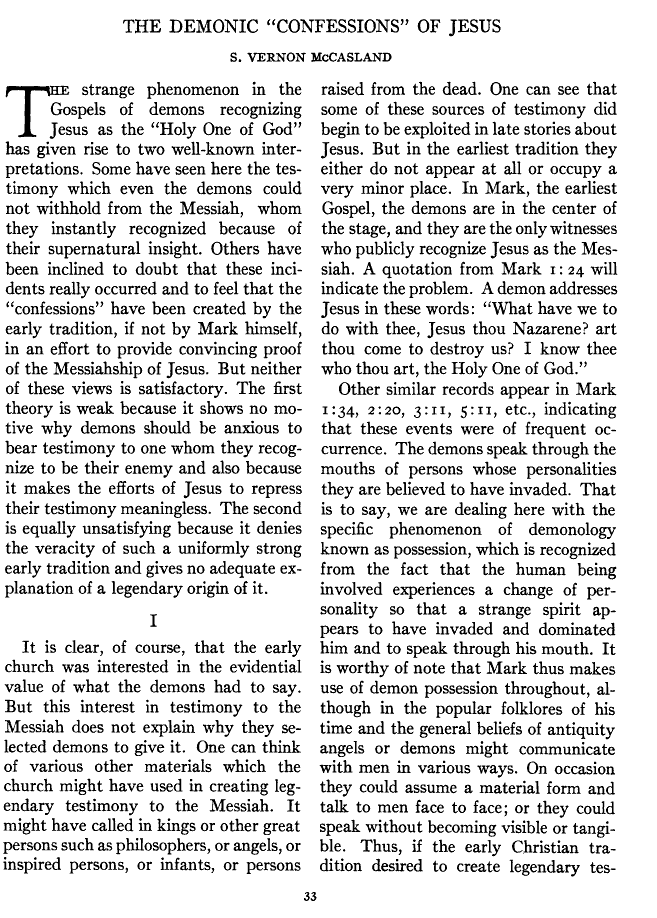
In the analysis below, we read that the tradition of demons declaring Jesus to be God's son and Messiah is too strong to be just dismissed as an invention by the early Church. Demons would be necessarily unreliable so why do the gospels even care what they say? Yet they care.
The analysis also says that the story itself makes no sense. Now it complains that if you say the stories are legends, the problem is you have no way to trace the legendary development and explain it. But we don't have to. We do not see what documents or stories preceded Mark. And there is nothing wrong with looking at something and seeing it is legend. It is nice if you can show how it developed but it is not a huge thing if you cannot.
I would add that the Bible says each person is made in the true image of God and that supersedes any carved image or icon. So if holy water is able to damage a demon's power in a possessed person, as Catholicism says, how come that person's divine image cannot? That is really occultism masquerading as religion. The demon should not be able to get in at all if you are a living icon or meant to be a temple of God.