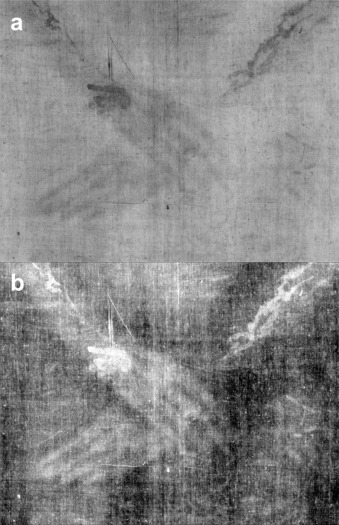
The Turin Shroud is the most famous relic in the world. Millions believe that it is the burial cloth of Jesus Christ, bearing his crucified and bloodied image. The cloth is kept in Turin, Italy. The cloth is an enigma, and many say it is a miracle.
It can be argued that despite all our technology today, we still do not know what Joseph Merrick suffered from. He was cruelly called the Elephant Man. Nobody says this is a miracle. There is more reason to call it a miracle—and a sign that God is evil—than there is to call the Shroud a miracle. As puzzling as the Shroud is, Merrick has surpassed it. And there are errors on the Shroud: the picture-like blood and the absence of distortion in the image are fatal errors. If God, not man, is responsible for the Shroud, then he makes mistakes.
We have to remember that the alcohol placebo effect is real. A person can think they have imbibed alcohol and act a bit like it. If there is no alcohol in their drink, this will still happen. If we think there is a possible miracle, this also affects us in ways we may not realize. We start to see supernatural intervention when there is none. The Shroud depends on a process like that. A placebo kicks in to protect the person from feeling bad about being wrong or silly.
There is no hard evidence, no sure indication, that the image on the cloth dates from Jesus’ time. It is odd that at the time of the Flagellant craze—when many were hurting themselves in imitation of Jesus’ sufferings and twisted, gory images of Jesus were fashionable—the gruesome horror of the Shroud man should be captured on cloth. If there is indeed a body involved in the image, and that is almost impossible, then the image is more likely of a medieval fanatic than Jesus.
There are errors, such as the fingers being too long. That was typical of images from medieval times, particularly icons, with Nosferatu-like fingers. The forefinger and the middle finger of the hand below are the same length. The back of the hand on top should be smeared with blood if it were really placed against wood and nailed. It looks as if the nail was hammered in and the man thrown into the cloth!
Experts say that if Jesus were nailed, he would have been nailed in the wrists so he could support his weight on the cross. The stretching is the reason why they cannot agree if the Turin image really shows wrist nailing or not.
Let us look at the book The Shroud, The 2000-Year-Old Mystery Solved, Ian Wilson, Bantam Press, London, 2010.
This pro-Shroud book gives us some information that draws us to conclude that the Shroud may not be authentic.
Page 8 has a diagram depicting how the theoretical body was put in the cloth. He is laid out in a bizarre position, with his head above the ground and legs bent. This is odd if the Shroud is big enough to cover a whole body. The position is clumsy. They would have laid him out flat. With rigor mortis starting, they would have had to.
The Shroud man's face seems to have been parallel to the cloth above it, as if it projected rays straight up to make an image. This would have been very hard to achieve and does not fit the Gospel accounts, where Jesus' burial was hurried. It indicates that a willful attempt was being made to reproduce Jesus' image.
Until Shroud believers are able to explain how a dead body can send rays up to burn an image into a Shroud covering it, they should not insist that there ever was a body in the Shroud.
Page 10 admits that the man's face looks like a mask with eyes like owls. Also, the face and hair look as if they are not part of the body, for there are no shoulders visible. The hands appear very clearly, but below the knees they fade, leaving the upper feet hardly visible.
The clarity of the face and hands indicates that somebody was hoping that Jesus' face and hands, his most important parts, would be the focus of the end product. This would indicate forgery.
Page 49 says that the Shroud shows Jesus was stabbed by the lance on the right side. We would expect him to be stabbed on the left, through the heart, to kill him. Wilson says that Roman soldiers were trained to stab the right during battle.
We can object to this, for the soldier was not battling Jesus. Also, why did he stab him there? The Gospel of John says the soldiers saw that Jesus and the others were dead, and one of them pierced Jesus with a lance. The stabbing makes no sense unless it was performed to be 110% sure that Jesus was dead, in which case it would have been done through the heart. John reports that blood and water came out. If it did, then he would have been stabbed again, this time through the heart.
Page 28 discusses Nicholas Allen's reproduction of the Shroud and says his method works. The only objection Wilson gives to Allen's claim that somebody used his technique in the Middle Ages to make the Shroud is this: nobody understood photography back then. But is it not more bizarre to believe that the Shroud image is inexplicable and one of Jesus' miracles? He then cites Sean Heckman, who says that it is nearly impossible for Allen's method to have been used in the Middle Ages. On page 29, a further objection appears: it says that if a forger created the image, it would be impossible to explain how forensic experts find the stains realistic. This would, however, only indicate that the Shroud may have been touched to the body of a man tormented to death for the purpose of making the relic after an image was made. There is no reason to believe that this body was used in making the image itself.
Page 29 mentions Luigi Garlaschelli's attempt to show that the Shroud could have been faked in the Middle Ages. He used a model coated in pigment and acid, put a linen sheet over it, baked the sheet to artificially age the acid, then washed the sheet and ended up with an image like the Shroud. Wilson, however, says the new image is very inferior to the Shroud and does not show the different grades of tone. But the gradations of tone could be explained by the age of the original image, the countless chemical and environmental changes it encountered over the centuries, and the artist's concern to show the face, hands, and side more than anything else. Also, Garlaschelli was making a better Shroud than the original!
If Garlaschelli's Shroud were time-traveled back to the Middle Ages and was still with us today, we know Wilson and co. would be claiming it was a miracle. DON'T LOSE SIGHT OF THE FACT THAT HIS REPLICA, LIKE MANY OTHERS, IS A WONDER BY THOSE MIDDLE-AGES STANDARDS! AND TIME WOULD MAKE THEM MORE MYSTERIOUS, FOR IT ALTERS CHEMISTRY AND MAKES IT HARDER TO BE SURE HOW IT WAS DONE.
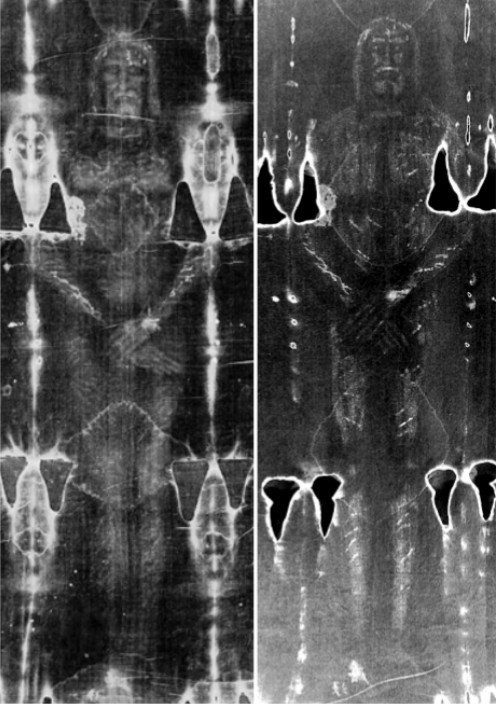
THE TURIN SHROUD LEFT AND THE GARLASCHELLI SHROUD RIGHT.
THE IMAGE ON THE RIGHT WOULD BE MORE AMAZING IF IT FADED OVER
CENTURIES.
IN MANY RESPECTS, THE GARLASCHELLI CLOTH IS BETTER.
NEITHER SHROUD IS PERFECT.
The Shroud being strange does not mean that it has to be a miracle.
BARBET
From the book The Shroud of Turin!! Is it Genuine or is it a Forgery? Dr. Johnson C. Philip, Dr. Saneesh Cherian, Edited by Gregory Anderson. Creative Commons. Copyright Philip Communication. First Edition 2014.
One of the best anatomical studies of Shroud man, was by Dr. Pierre Barbet, a well-known French surgeon. His book was the result of 15 years of study, and he proclaimed that the physiology and anatomy of the man on the Shroud was anatomically perfect. However, all of these studies were based upon investigations of available photographs and were not based upon any kind of direct access or observation of the Shroud. Thus, their evidence was circumstantial at best, severely limited by the quality (or lack of quality) of the photographs during an era when photography was still poorly developed.
Conclusion:
The Turin Shroud, while intriguing, shows numerous anomalies and historical inconsistencies. Evidence suggests it could easily be a medieval creation, and its mystery does not require a miraculous explanation.
Bibliography
Barbet, Pierre. The Shroud of Turin: Is It Genuine or Is It a Forgery? Dr. Johnson C. Philip, Dr. Saneesh Cherian, editors. Creative Commons, Philip Communication, First Edition, 2014.
Wilson, Ian. The Shroud: The 2000-Year-Old Mystery Solved. Bantam Press, London, 2010.
Garlaschelli, Luigi. “Reproduction of the Shroud of Turin Using Medieval Techniques.” Journal of Forensic Studies, referenced in Wilson, Ian, 2010.
Allen, Nicholas. “Experimental Reproduction of the Shroud of Turin.” Historical Chemistry Review, referenced in Wilson, Ian, 2010.