The Turin Shroud is the most famous relic in the world. Millions believe that it
is the burial cloth of Jesus Christ bearing his crucified and bloodied image.
Jesus was allegedly wrapped in the Shroud of Turin. Despite all the strange
things that seem to be in the Shroud’s favour, the supporters choose to ignore
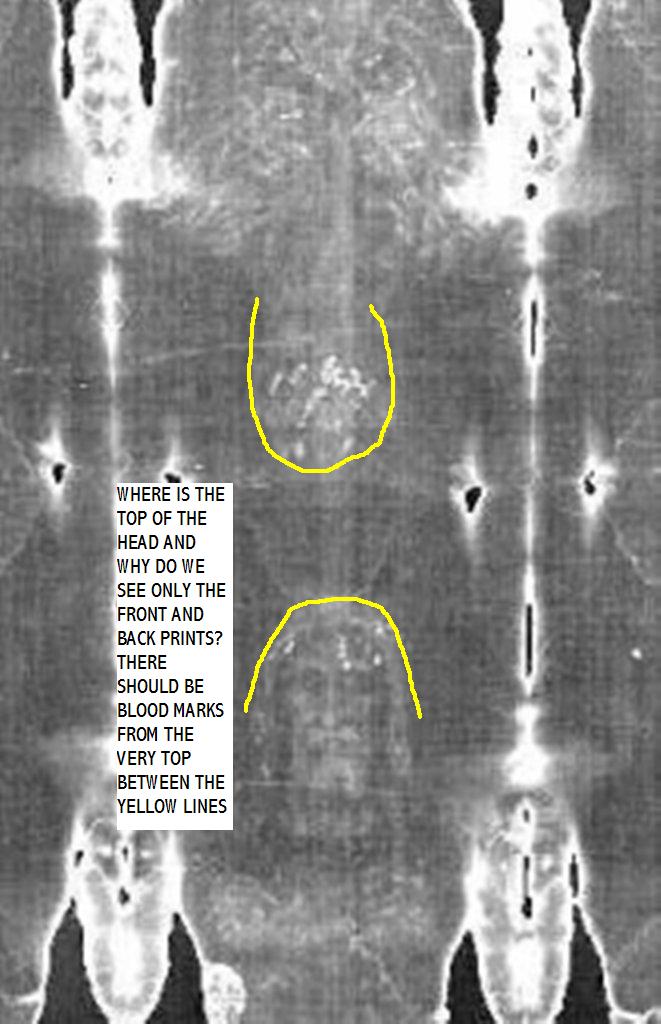
proof on the cloth itself that nobody was ever wrapped up in it. THE TOP OF THE
HEAD ITSELF IS NOT SEEN! If the image had been wrapped around a head you would
not see this effect. The cloth should show blood marks and images as if it were
wrapped around a head. Instead, it looks as if the back and front were put on
separately with no connection in between. There should be a connection if the
cloth covered a body. It is like somebody taking a photo of you from the front
and then one from the back and putting them together with the head on each photo
touching. It is not a natural effect when you have a cloth that a man was
supposedly wrapped up in and which went over the top of his head.
The buttocks of the shroud man are round. Real dead bodies that are laid down
get flattened buttocks. Whatever the image is it is not the image of somebody
lying on the cloth.
THE STIGMATA
What makes the Christians believe the Shroud man is Jesus when they believe in
stigmatists, people who bear the marks of Christ’s cruel death by the power of
God?
The Shroud man could be an unknown stigmatist who had gone through a
beating that dislocated some of his joints. The Shroud man could be another
Jesus. He could be a more convincing one if it is true that the Shroud indicates
resurrection from the dead. He would be proof that it is mad to believe in any
resurrections or Messiahs for they claim to be the only saviours and yet there
is no reason to favour one above the other.
APPENDIX
The Shroud of Turin presents a significant difficulty in the
contention that it wrapped a human head in the way one might expect
a burial cloth to do. Researchers have repeatedly pointed out that
there is no visible image of the top of the head between the frontal
and dorsal (back) head‑images, despite the fact that the linen is
continuous over that region. As one analysis puts it: “There is also
no image corresponding to the top of the head: the expected union
between the frontal and the dorsal image is missing, even though the
canvas is continuous over the whole body.”
Cesan
+2
Shroud
+2
In addition, a summary of the phenomenon states: “It is important to
note … there are no images of the sides of the body or the top of
the head, and the front and dorsal images are head‑to‑head.”
ASNT
+1
This omission is problematic if the cloth truly wrapped the entire
head in ordinary contact, as burial shrouds often do. One study
observes that “the top of the head is also missing between the
frontal and dorsal images, in spite of the fact that the Shroud is a
single continuous piece wrapped over the whole body.”
Shroud
The absence of an image in the crown region suggests either a
non‑contact region (where the cloth did not touch the scalp), or the
image‑forming mechanism did not register that section, or perhaps
the object wrapped was not a full three‑dimensional head.
Because of this discrepancy, some experts now argue that the image
cannot be the result of a simple wrap of cloth over a real human
body. For example, the modelling expert Cícero Moraes states that
the image on the Shroud “is more consistent with a low‑relief
matrix” rather than the draping over a human body.
Phys.org
+2
The Catholic Herald
+2
The lack of anatomical continuity at the top of the head supports
this conclusion, because a human skull would expect to make contact
(or near contact) with the cloth and therefore leave a trace.
In light of these findings, one must conclude that the absence of a
top‑of‑head image is a serious structural problem if the linen ever
wrapped a human head in a normal burial context. Whether this
undermines the shroud’s claim to be the burial cloth of Jesus of
Nazareth depends on further interpretation of how the image was
formed—but from a purely anatomical and textile perspective, the
missing head‑top region remains a noteworthy anomaly.
Experts have measured the distance between the crown region of the
frontal image and the back of the dorsal image. If the Shroud were
actually wrapped around a human head, that distance should roughly
match the circumference or at least the thickness of a skull —
perhaps 20–25 cm (8–10 in), depending on the individual. But
measurements consistently show that the gap is much larger than the
anatomical distance of a human head, on the order of 10–15 cm more
than expected.